
Service
On-Site Oven Construction
We build the oven where it will stand — dome, hearth, insulation, flue, and finish.
Quote within 24 hours
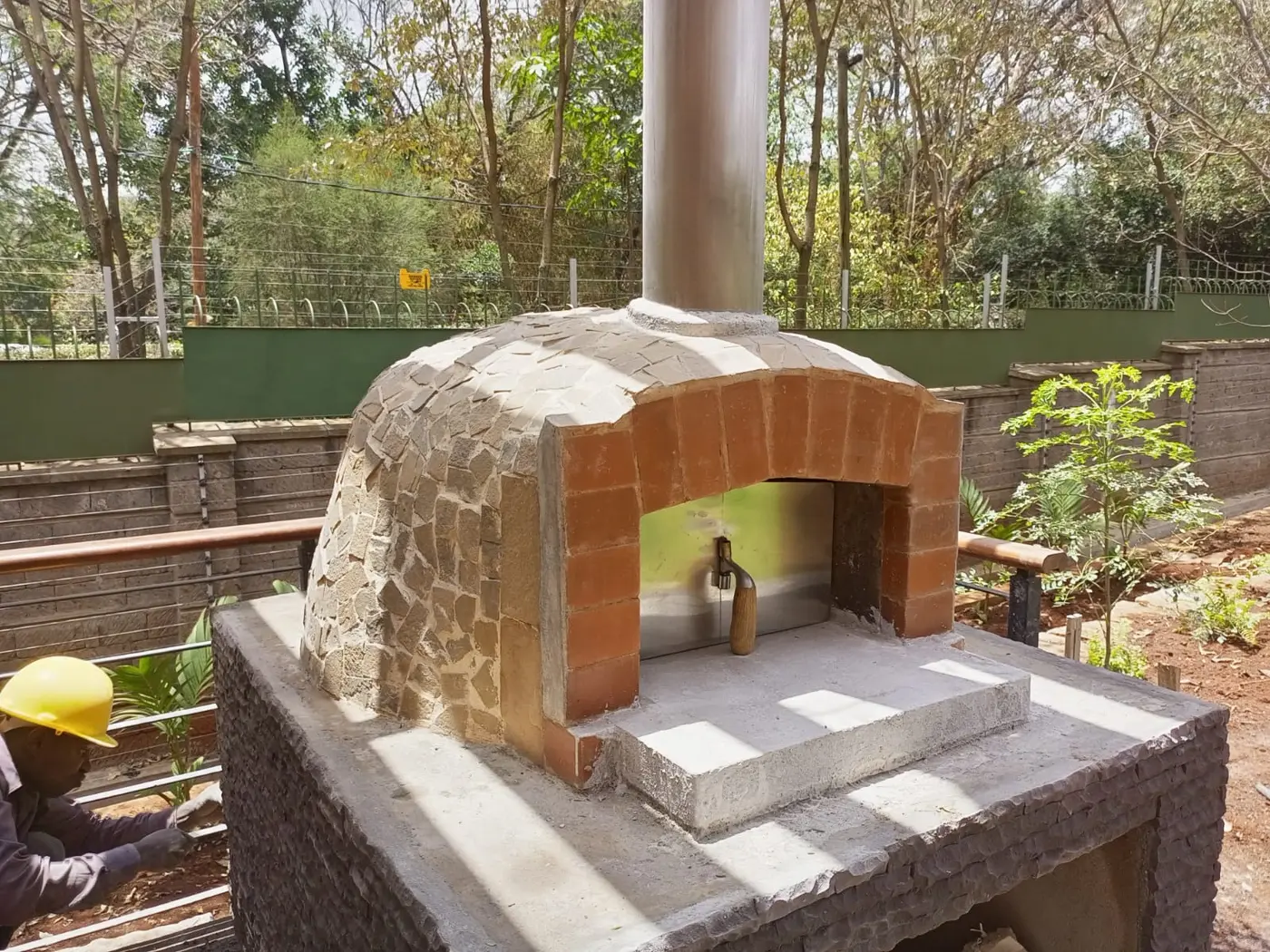
Most commercial ovens cannot be delivered finished. They are too heavy to crane into a working kitchen, or the space will not take a standard footprint, or the only route in has a step in it. So we build in place, course by course, and hand over an oven that has already been fired to working temperature.
What a site build involves
It starts with a survey rather than a quote. We look at floor loading, the extraction route, clearance to combustible structure, working space in front of the mouth, and how the oven will actually be used through a week of trading. That produces a written specification and a real figure. Nothing is ordered before you have agreed it.
Then the build. A calcium silicate base board isolates the hearth from the stand, so heat goes up into the oven rather than down into masonry you are not cooking on. The cooking floor is 65 mm high-alumina firebrick laid dry, which means individual tiles can be lifted and replaced years later without disturbing the dome. The dome itself is cut firebrick bedded in refractory castable, raised to a profile that returns radiant heat onto the floor — the reason a proper dome bakes in 60 to 90 seconds and a flat-roofed box oven does not.
Over that goes 50 mm of ceramic fibre blanket and 100 mm of rockwool. That combination is what keeps heat in the oven overnight instead of radiating it into your kitchen, and it is the first thing cut when someone quotes cheap. Outside is rendered, tiled, or clad to whatever finish the room calls for.
How long it takes
Five to nine days of construction for a typical commercial dome, plus the finish, plus a six-day curing schedule. Allow three to five weeks from deposit to first pizza. We can often run finish work in parallel if an opening date is tight — the curing week is the one stage we will not compress, because an oven fired hard while still wet cracks, and a cracked dome is a rebuild rather than a repair.
The full stage-by-stage timeline sets out what happens when.
Where a site build is the only option
- First-floor and mezzanine kitchens, where a finished oven cannot be lifted into position.
- Enclosed courtyards and anywhere without a clear route wide enough for a pallet truck.
- Anything above about 110 cm — a finished dome at that size approaches two tonnes.
- Retrofits into existing counters or garden walls, where the oven has to be shaped to the space.
If your site does allow a finished unit, we will say so — it is usually quicker and cheaper. The access checklist is here.
Curing, and why we do it ourselves
A newly built oven holds a great deal of water — in the castable, absorbed into the brick, and in the render. It has to leave slowly. Fire the oven hard before it has, and that water flashes to steam inside the structure, expanding roughly 1,600 times. The result is spalled hearth brick or a cracked dome.
Handing over an uncured oven with a printed schedule transfers the riskiest week of its life to whoever is least equipped to manage it. So we run the fires ourselves, on a rising schedule, and hand over an oven already proven hot. The schedule is published here so you can hold any builder to it.
What is included
- Site survey and written specification, free across Kenya.
- All refractory materials — high-alumina firebrick, refractory castable, ceramic fibre, rockwool — from our own stock.
- Base or stand, and any reinforcement the survey identifies.
- Insulated twin-wall flue, fire-stopped, flashed and terminated above roofline.
- The finish you specify, from render through to mosaic or stainless.
- Full curing schedule fired by our team.
- Handover walkthrough covering firing, temperature management and maintenance.
- Two years structural warranty.
Why the materials matter here
Brillian supplied refractory to industrial clients across East Africa before we built ovens with it. That is the practical reason we can answer for every layer of an oven we build rather than reporting what a supplier told us, and why the specification does not shift from one of our builds to the next.
It is also why relining ovens other people built is routine work for us.
Where we build
On-site construction across Kenya. For Uganda and Tanzania our team travels, and we coordinate the survey with the build visit to keep the trips down. Tell us where the oven is going and what you cook, and we will come back within 24 hours.
Also from Brillian
- 01
Oven Design & Consultation
Sizing, siting, and extraction worked out before anyone orders brick.
- 02
Refractory Relining & Repair
Cracked domes, spalled hearths, and failed castable brought back to service.
- 03
Oven Servicing & Maintenance
Scheduled inspection, flue cleaning, and burner servicing to keep an oven in service.
- 04
Flue & Extraction Installation
Insulated flue systems and hood integration that meet draw and clearance requirements.