Buying Guides
Buy Finished or Build On Site?
A finished oven is quicker and usually cheaper — until access defeats it. How to tell which route your site allows, and the weight and doorway numbers that decide it.
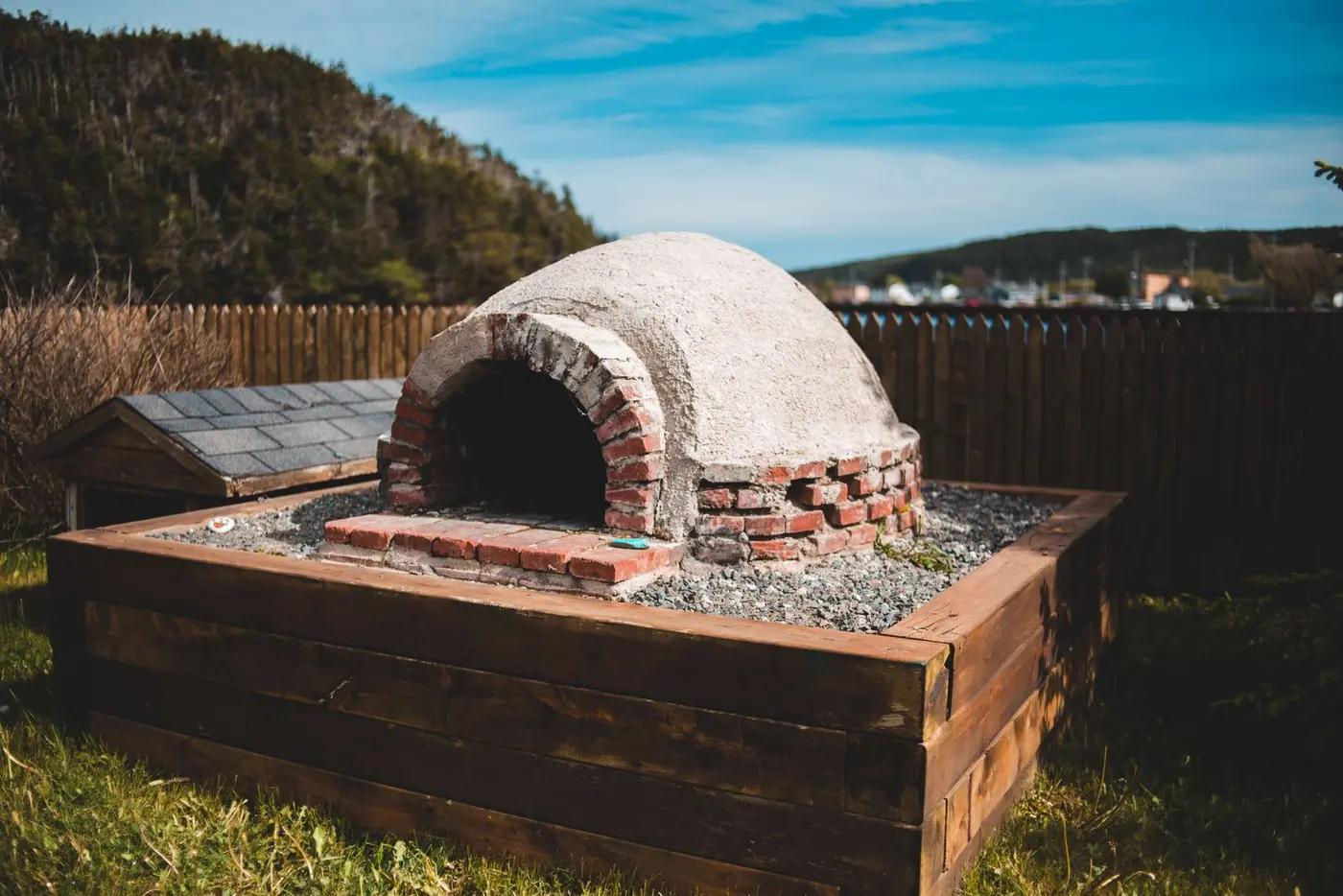
There are two ways to get a brick oven onto your premises. We build it in our Nairobi workshop, cure it, and deliver it complete on a stand. Or we build it in position, course by course, over a week or so.
Both produce the same oven. What differs is cost, disruption, and whether your site physically permits the first option. Most people assume they have a choice; often the site has already decided.
The short answer
If the oven is under about 110 cm, is going to a ground floor, and there is vehicle access with a clear path at least 900 mm wide, a finished unit is usually the better buy. Otherwise it is a site build.
Finished units: what you gain
- Days rather than weeks on your premises. Delivery and positioning is often a single day. For a trading kitchen, that difference is worth real money.
- Cured before it arrives. We run the full six-day curing schedule in our own yard, so the oven arrives proven at working temperature rather than needing a week of careful fires in your space.
- Usually cheaper. Workshop labour is more efficient than site labour. No travel, no setting up and breaking down, no working around your service.
- Relocatable. If you move premises, the oven can in principle come with you.
Finished units: what stops them
Weight. A 90 cm oven on a stand is around 1.1 tonnes. A 100 cm is about 1.4. A 120 cm approaches two. Beyond roughly 1.5 tonnes you are into crane or forklift territory, and the question stops being about the oven and starts being about the yard.
Access. The path from the vehicle to the final position has to take the oven on a pallet truck or skates: adequate width, no steps, no sharp turns in a corridor, doorways it will actually pass through. A finished 100 cm dome is roughly 1400 mm across including the stand.
Floors. Anything above ground level needs the loading checked, and the route needs checking too, not just the destination.
Site builds: what you gain
- No access constraint at all. Materials come in by hand, in manageable loads. This is the reason first-floor and enclosed-courtyard ovens exist.
- Dimensions adapt to the space. An oven built in place can be sized to the alcove it occupies rather than the alcove being adapted to a standard product.
- It integrates with existing masonry. Built into a boma wall, a counter, or an outdoor kitchen, it reads as part of the structure rather than as equipment that arrived.
- No practical size ceiling. Our 130 cm bakery oven at 2.6 tonnes is only ever a site build.
Site builds: what they cost you
Time on your premises. Five to nine days of construction, plus the finish, plus the curing week. In a working kitchen that is disruption you have to plan around. Our build timeline guide sets out the stages.
Weather, for outdoor builds. Render will not cure properly in sustained rain, and the rains cost days.
Coordination. If structural work is needed first, that is a separate trade and a separate lead time before we can start.
The access checklist
Walk the route yourself before you assume a finished oven is possible:
- Can a vehicle get within about twenty metres of the final position?
- Is the whole route at least 900 mm wide, including through doorways?
- Are there steps, thresholds, or level changes? Any step is usually decisive.
- Are there tight turns — a corridor into a doorway is the classic failure?
- Is the floor along the route able to take a tonne-plus on a pallet truck?
- Is the destination on the ground floor, or has the loading been checked?
One "no" generally means a site build. That is not a worse outcome — it is simply a different job, and one we do every week.
The hybrid route
For some sites we build the dome in the workshop, cure it, deliver it as a unit, and then build the stand, insulation shell, flue, and finish in place. That gets you workshop-quality curing on the part that most benefits from it while keeping the delivered weight manageable.
It suits sites where access is tight but not impossible, and where you want to minimise the days our team spends in your kitchen.
How to decide
Send us photographs of the route and the intended position, and the dome size you are considering. We can usually tell you within a day which route your site allows — and if both are viable, what each would cost.
That conversation is part of our design and consultation service, and it happens before anything is ordered. Getting it wrong is expensive; getting it right takes a site visit and an afternoon.
Two sites, two answers
A ground-floor terrace restaurant with yard access. A 100 cm oven, vehicle to within ten metres, level paving the whole way, doorway 1.1 m. A finished unit is straightforward: delivered on a stand, positioned in a morning, trading the same evening. Cheaper and faster, and the curing already done in our yard.
A first-floor kitchen above a retail unit. Same 100 cm oven, but the only access is a staircase with a half-landing. Nothing weighing 1.4 tonnes is going up there. The floor also needs checking, and it turned out to need a spreader plate. Site build, seven days, plus the structural work first.
Neither client had a choice to make. The site made it for them, and knowing which one you are saves a great deal of budgeting against the wrong number.
What delivery day actually involves
For a finished unit: the oven arrives on a pallet, comes off with a tail-lift or forklift, and moves on skates or a pallet truck to position. It needs the route clear, the destination prepared, and someone to confirm the final position before it is set down — moving it afterwards is a much bigger job than moving it the first time.
Allow half a day, and do not schedule it for a service day. We have never regretted taking longer over positioning and have several times regretted rushing it.
The hybrid route in practice
Where access is tight but not impossible, we sometimes build and cure the dome in the workshop, deliver it as a unit, then build the stand, insulation shell, flue, and finish in place.
You get workshop-quality curing on the component that most benefits from it, while the delivered weight stays manageable. It suits kitchens that want to minimise the days our team spends in their space without accepting the access limits of a fully finished oven.