
Industry
Hotels & Resorts
Feature ovens for show kitchens, terraces and poolside dining — built to be looked at as well as cooked in.
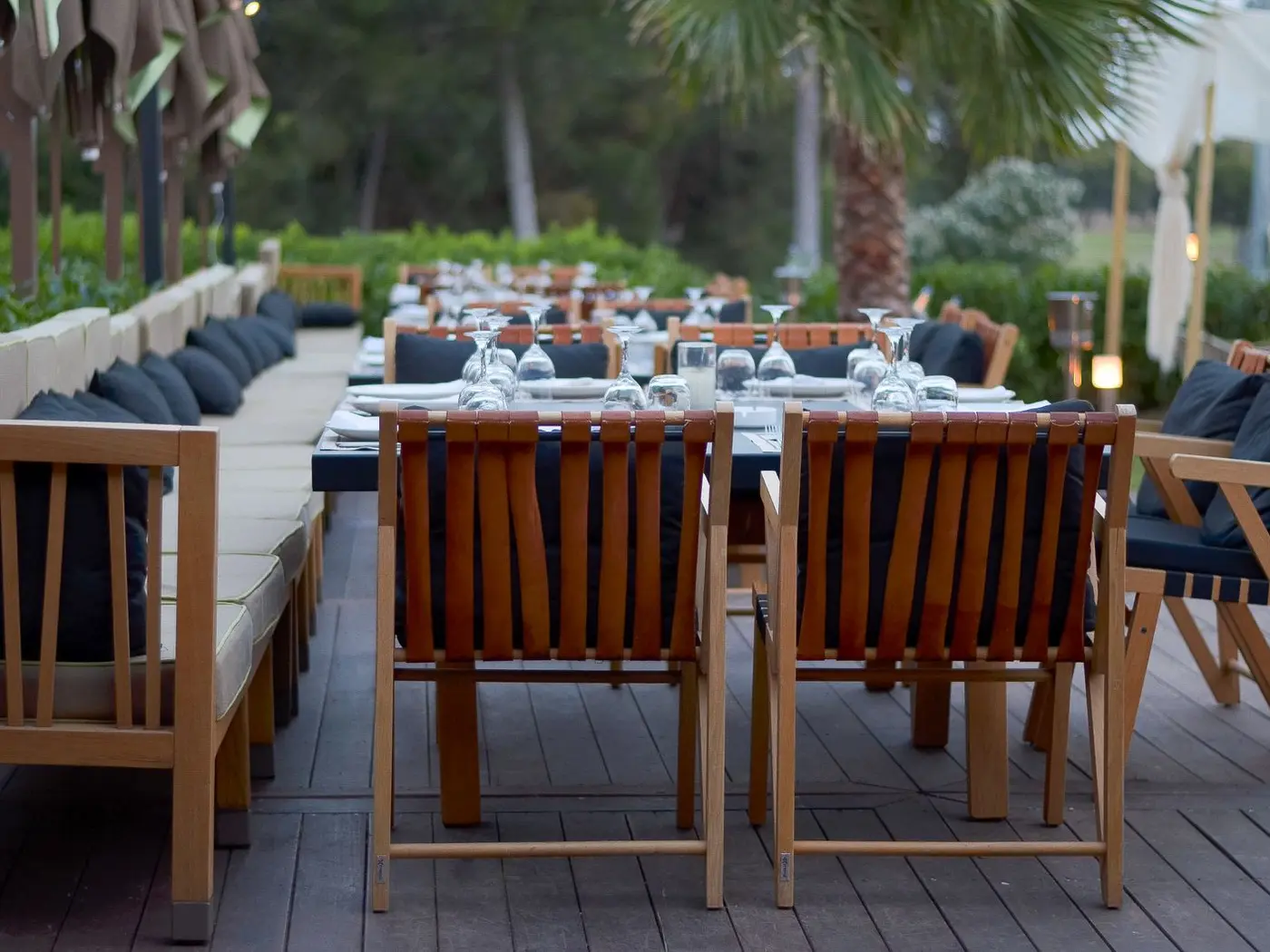
In a hotel the oven is often part of the room. It has to cook properly and it has to bear looking at, and those two requirements pull the specification in different directions.
Guest-facing finishes
The oven inside the render is identical whether the outside is plain cement or hand-laid mosaic — but the labour is not. A rendered dome is a couple of days; tadelakt or detailed mosaic can take a week or more.
That makes finish the easiest place to control budget, and the easiest place to spend it well. If the oven faces guests it is doing marketing work as well as cooking, which justifies the finish. If it lives in a back kitchen, render it and put the money into the dome.
We finish in render, tadelakt, mosaic tile, natural stone, and stainless cladding, and we site the oven for sightlines as well as extraction.
Multi-shift kitchens
Hotels rarely have the same person opening and cooking. Breakfast-through-dinner operations run several shifts, and oven competence cannot be guaranteed on all of them.
That is the strongest argument for gas in a hotel setting: an LPG dome comes to temperature during setup at the turn of a valve and holds it all day without drift. Any trained operator can run it. Where the menu wants wood for guest-facing service, a hybrid covers both.
Function and banqueting loads
Conference lunches and weddings are not the same problem as à la carte service. Two hundred and fifty covers in a compressed window needs an oven with enough thermal mass to hold the floor temperature for hours rather than recovering between orders.
This is where a 120 cm dome earns its cost. Six pizzas at a time, 70 to 80 an hour, and a floor that does not sag after the first hundred covers.
Outdoor and resort builds
Terrace and poolside ovens have to survive the site, and coastal humidity is a different problem from highland rain. The render specification, the flue cap, and the weathering detail are set for the location rather than lifted from a standard drawing.
Worth thinking about the walk, too. We have seen beautiful terrace ovens go unused through a wet season because nobody considered whether staff would cross open ground in a downpour during service. Our siting guide covers the practical constraints.
Keeping it running
A hotel oven that stops is a menu item off and a guest complaint. An annual service — flue swept, refractory inspected, burner tuned and certified — costs far less than the trading disruption of an unplanned failure.